Why Private Charter Exceeds First Class From Boca Raton
When a sophisticated individual considers elevated air travel departing from the exquisite locale of Boca Raton, the options presented—first class commercial seating versus a dedicated private charter—often appear to be merely two different degrees of luxury. The initial assumption is that both promise exceptional comfort and efficiency far surpassing standard air transport. However, this view dramatically underestimates the profound difference between renting premium amenities within an existing system, and possessing genuine command over one’s entire journey. To truly understand modern mobility, one must look past mere seating assignments and examine the foundational element of control itself.
The essence of elite travel is not found in the quality of a seat or the shine of an amenity package. It resides instead in the absolute freedom from external variables—the power to dictate time, route, and privacy without negotiation with the operational flow of countless other people’s lives. This critical difference makes the private jet experience fundamentally superior to even the most luxurious first class commercial offering.
Re-evaluating Luxury Mobility: Beyond Seat Comfort
To properly analyze this choice, we must define what “luxury” means in the context of modern travel. For centuries, luxury was defined by material goods—fine materials, opulent furnishings, and dedicated service staff. While first class certainly delivers on these visible comforts, a true 21st-century definition incorporates non-material assets: time, discretion, and total flexibility. When we weigh these intangible elements, the operational framework provided by a private jet charter from Boca Raton emerges as having an unmatched value.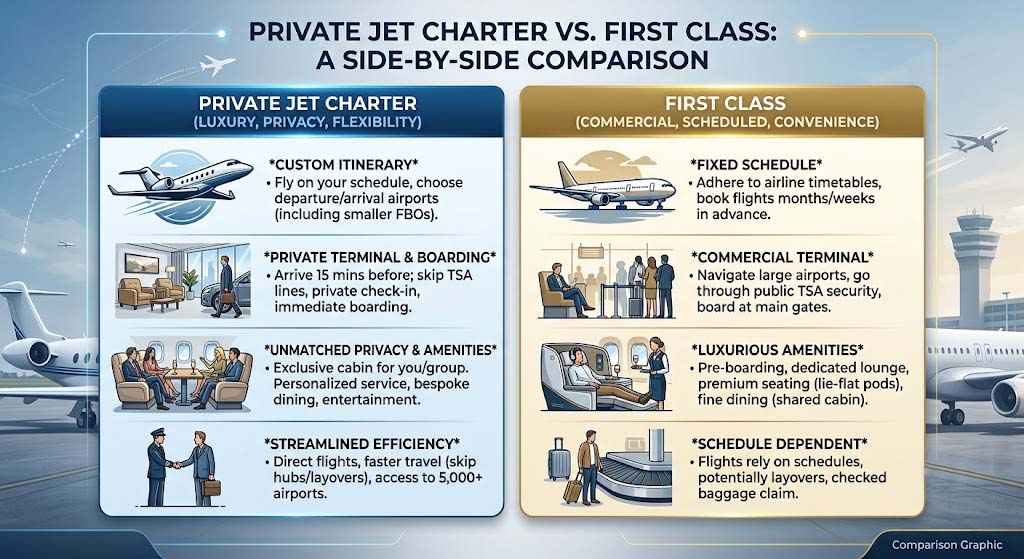
The Inherent Limitations of Commercial Systems
First class travel, while undeniably plush, operates within a highly constrained ecosystem. It is fundamentally predicated on the massive choreography of commercial air traffic control systems designed to move thousands of passengers efficiently through standardized hubs. This systemic dependency means that every component—from ground transport timing to gate assignment—is subject to external variables: minor mechanical issues, unexpected weather fronts, or sheer operational congestion at major airport terminals. Even when things proceed flawlessly on paper, the reality is one of collective dependence. The moment a delay ripples out from an entirely separate flight path hundreds of miles away, your entire itinerary is susceptible.
These external constraints strip away any sense of total control. While dedicated lounges offer temporary refuge from terminal chaos, they cannot shield you from the uncertainty of when you will actually be seated or boarding. This systemic reliance means that first class travel purchases premium *comfort*, but it does not purchase reliable *control*. For those who manage complex schedules—executives, international diplomats, high-profile artists—the potential for disruption inherent in commercial scheduling represents a significant operational risk that few resources can truly compensate for.
The Absolute Autonomy of the Private Charter Model
A private charter from Boca Raton fundamentally bypasses these systemic vulnerabilities. The transaction is not a seat purchase within an operational schedule; it is the reservation and deployment of dedicated airspace resources for a singular purpose—your needs. This level of autonomy means that the timeline is governed by the client’s agenda, not by the aggregated timetable of hundreds of other flights. Whether your destination requires a discreet approach to a small regional airport or necessitates flying around restricted commercial corridors, the charter platform provides the capability and clearance necessary for immediate operation. This radical self-determination in travel logistics represents an irreplaceable value.
The sheer power of being unconstrained is what makes the charter superior. It allows for a level of planning granularity that commercial travel simply cannot replicate, granting peace of mind—a commodity far more valuable than any first class amenity package.
The Operational Supremacy: Timing and Seamless Execution
When evaluating true efficiency, the focus must shift to how smoothly the entire process—from the moment you leave your property in Boca Raton until your final stop—flows together. The seamlessness of a private charter is unmatched because every single logistical piece (ground transfer, aircraft readiness, air traffic clearance) is orchestrated and managed by one singular provider, with no reliance on third-party scheduling coordination.
Total Schedule Sovereignty: Controlling the Clock
Time management is arguably the most critical metric for discerning travelers. The ability to depart at precisely the moment required, regardless of external pressure, is what defines superior service. With a private charter, you own that clock; no commercial timetable can dictate its pace. If an afternoon commitment runs fifteen minutes over schedule, simply adjusting the flight manifest and departing without penalty or delay is routine. This eliminates “dead time”—the often-wasted hours spent waiting for connecting flights, checking in repeatedly, or navigating congested terminal areas typical of even first class travel.
This ability to maintain temporal sovereignty means that your journey feels cohesive and deliberate, rather than a series of stressful transitions between scheduled appointments. For professionals who must meet multiple commitments across diverse locations, the consistent reliability offered by scheduling around their needs is an undeniable functional advantage over commercial options which demand that the schedule be built *around* theirs.
The Operational Advantage of Direct Routing
Furthermore, the flexibility to utilize non-commercial or secondary airfields is a profound operational edge. While major international hubs are impressive gateways, they are often unnecessarily large and can add superfluous time simply because they are designed to handle maximum volume. The private charter allows for direct routing to smaller, more convenient airports—airports that might be closer to the final point of interest but are typically inaccessible or inconveniently scheduled for commercial traffic. This ability to tailor the landing zone based on proximity and need radically shortens the total time commitment from Boca Raton.
The Value of Privacy: A Sanctuary in the Sky
Perhaps the most powerful argument for choosing a private charter in Boca over first class lies in the sheer level of privacy it affords. The journey becomes an exclusive, controlled sanctuary—an environment where conversations can be held without the risk of overheard dialogue, and work sessions can proceed without interruption from public life.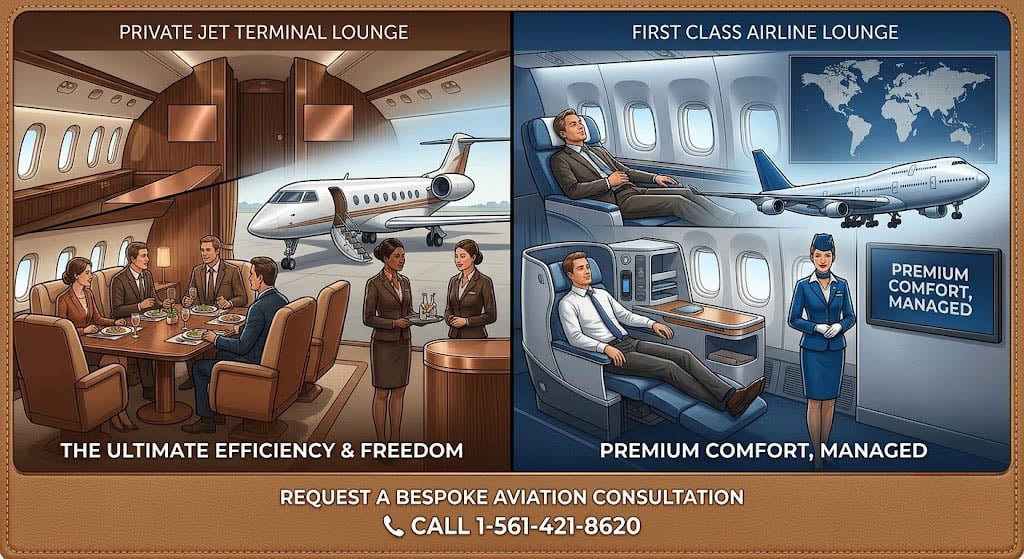
Discretion as a Professional Necessity
For those whose work requires absolute confidentiality, the public environment of a major airport is an operational liability. The constant flow of strangers, security checkpoints, and publicly audible announcements represents a loss of discretion. A chartered flight eliminates this vulnerability entirely. It moves the operation into a controlled bubble—a private space where individuals can conduct sensitive business meetings or receive confidential briefings without any fear of being observed by passersby or overheard by fellow passengers in an open first class cabin. This shield of privacy is not merely desirable; it functions as a critical piece of infrastructure for high-stakes professional activity.
Designing the Travel Environment
The interior layout of a private jet can be configured to perfectly match the mission at hand. Need space for multiple people to spread out on large conference tables? The charter accommodates this. Do you require a quiet area dedicated solely to personal rest and reflection? It can be engineered that way. First class seating, conversely, is fixed by the airline’s commercial template; while comfortable, it cannot dynamically reshape itself around the unique functional requirements of its occupants. This customization ability elevates the **private charter** from merely transportation to a fully adaptable mobile workspace or sanctuary.
A Final Consideration of Investment and Return
When viewing the expenditure on air travel, it should not be evaluated based purely on a direct cost comparison. Instead, one must calculate the total return on investment—which includes time recovered, stress mitigated, and opportunities secured through absolute control. While first class offers tangible luxury amenities (better food, enhanced lounge access), these benefits are limited by the rigid operational box of commercial travel. The private charter, however, provides a multi-faceted value: it delivers supreme comfort plus temporal sovereignty plus total discretion.
In the contemporary landscape of demanding schedules and high-stakes professionalism, the capacity to dictate your own operational environment remains the definitive luxury. For travel originating from the exceptional vantage point of Boca Raton, choosing a private charter is not merely an upgrade in comfort over first class; it represents a fundamental elevation into a superior category of mobility—one defined by autonomy, flawless timing, and absolute privacy.
Loading Widget...